

Monday, 26 January 2026: NZD/JPY and AUD/JPY are the currency pairs I am most interested in during the upcoming week. This is down to the yield divergence opening up as the market narrative adjusts to a “Risk-On / Yield Hunt” mood following the US tariff walk-back.
Traders are selling low-yielders like the Yen to fund positions in economies with tight labor markets like Australia. The “Last Hawk” status of the RBA is the dominant theme offering a structural tailwind.
Watch the Australian CPI data on Wednesday, January 28. A hot print there likely guarantees an RBA hike. After that, focus shifts to the RBA meeting on February 3.
AUD/JPY: Highly Convincing Bullish Sentiment That May Fade In The Coming Days Due To Tariff Headlines
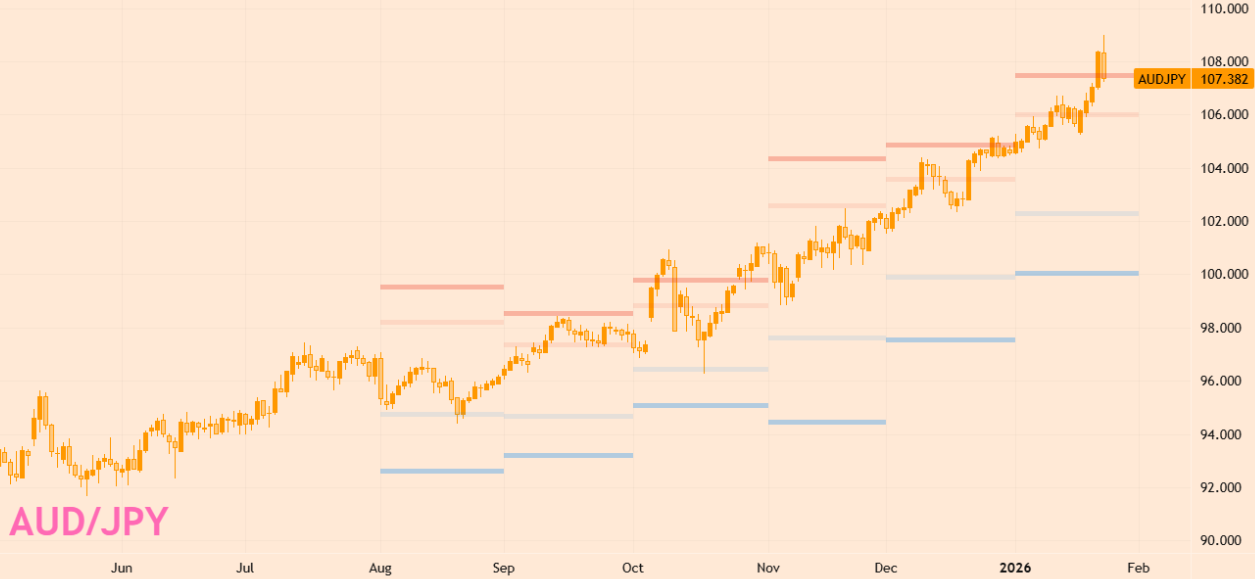
You have seen the Aussie surge against the Yen recently, fueled by that massive 65,200 jobs beat which forced traders to bet on a Reserve Bank of Australia hike to 3.85 percent on February 3. While the Bank of Japan stood frozen at 0.75 percent, the yield gap blew out. Over the coming weeks, I expect this carry trade to target higher levels as Japan’s fiscal gridlock keeps the BoJ sidelined. It is a highly convincing setup if the January 28 CPI print confirms sticky inflation, though you must remain alert for any Chinese iron ore volatility (https://tradingeconomics.com/commodity/iron-ore).
NZD/JPY: Highly Convincing Bullish Sentiment That May Fade In The Coming Days Due To China Data
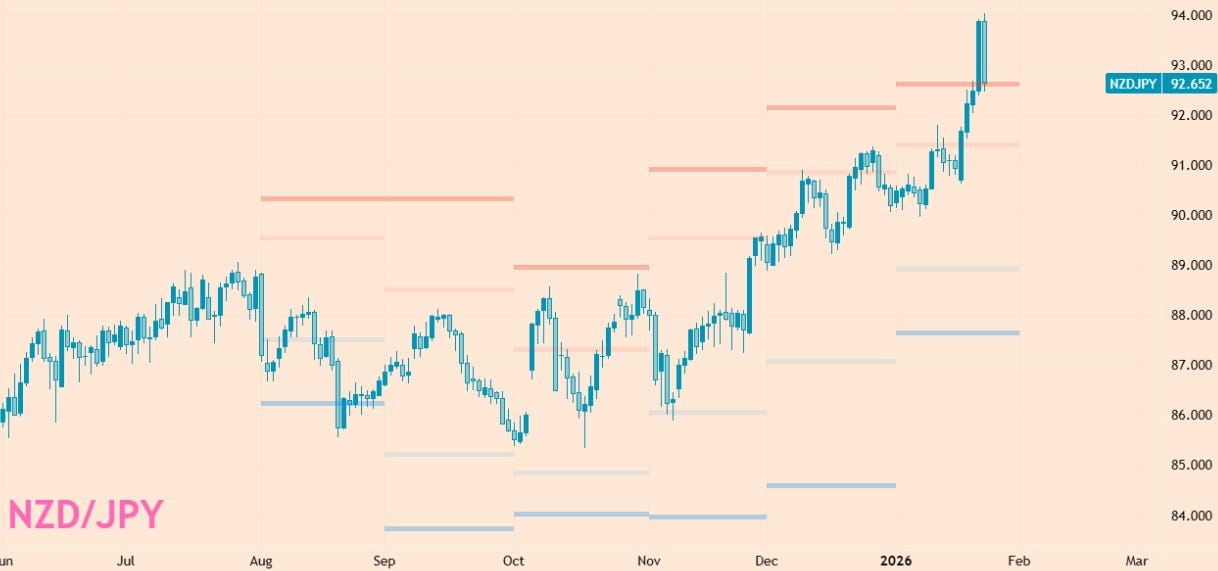
The Kiwi has staged a serious comeback, ripping off the lows after a hot 3.1 percent inflation print killed near-term RBNZ cut bets. Over the coming weeks, I expect this pair to climb further as the RBNZ holds rates steady while the BoJ remains paralyzed by political gridlock, widening the yield advantage institutional carry traders love. This is a highly convincing buy-on-dips scenario, aligning perfectly with global risk-on flows. However, keep a close eye on Chinese dairy demand—if property sector weakness hits export volumes, this sentiment could dissipate quickly (https://tradingeconomics.com/new-zealand/inflation-cpi).
Remember to include Fundamental Analysis into all your trade plans.
DISCLAIMER: The information printed here is informational only, NOT advice. Trading involves risk, and you could lose money.