

The past few days have seen global markets navigating treacherous waters, largely driven by severe geopolitical escalation in the Middle East. With the Strait of Hormuz effectively blockaded and direct conflict between the US, Israel, and Iran intensifying throughout late April 2026, energy markets have experienced massive swells. Brent crude recently surged past 118 USD per barrel, sending a massive inflationary pulse across the globe. As we look to the upcoming days and weeks, the primary focus will be on how central banks weather this stagflationary storm. Safe-haven assets and commodity-backed currencies are catching powerful tailwinds, while energy-dependent nations are taking on water.
Navigating these cross-currents requires matching currencies with vastly diverging fundamental strengths. For the week ahead, our focus is anchored on CAD/JPY and EUR/CHF. We have a highly confident conviction in these pairs because they perfectly isolate the current macroeconomic extremes.
The Canadian Dollar (CAD) is riding a massive wave of oil-driven export revenue, acting as a sturdy vessel in the geopolitical storm. Conversely, the Japanese Yen (JPY) is heavily burdened by its reliance on imported energy and a central bank that remains hesitant to aggressively tighten, keeping its policy rate at 0.75 percent. This makes CAD/JPY a prime candidate for upside momentum.
Meanwhile, EUR/CHF captures the stark European dichotomy. The Euro Area is heavily exposed to the energy shock, facing plummeting industrial sentiment and looming stagflation. In contrast, the Swiss Franc (CHF) remains the ultimate safe harbor, catching heavy commercial bids. By pairing the fundamentally robust CAD and CHF against the vulnerable JPY and EUR, we align our trades with undeniable institutional flows, watching closely for temporary sentiment shifts to optimize our entries.
POTENTIAL BUY CAD/JPY
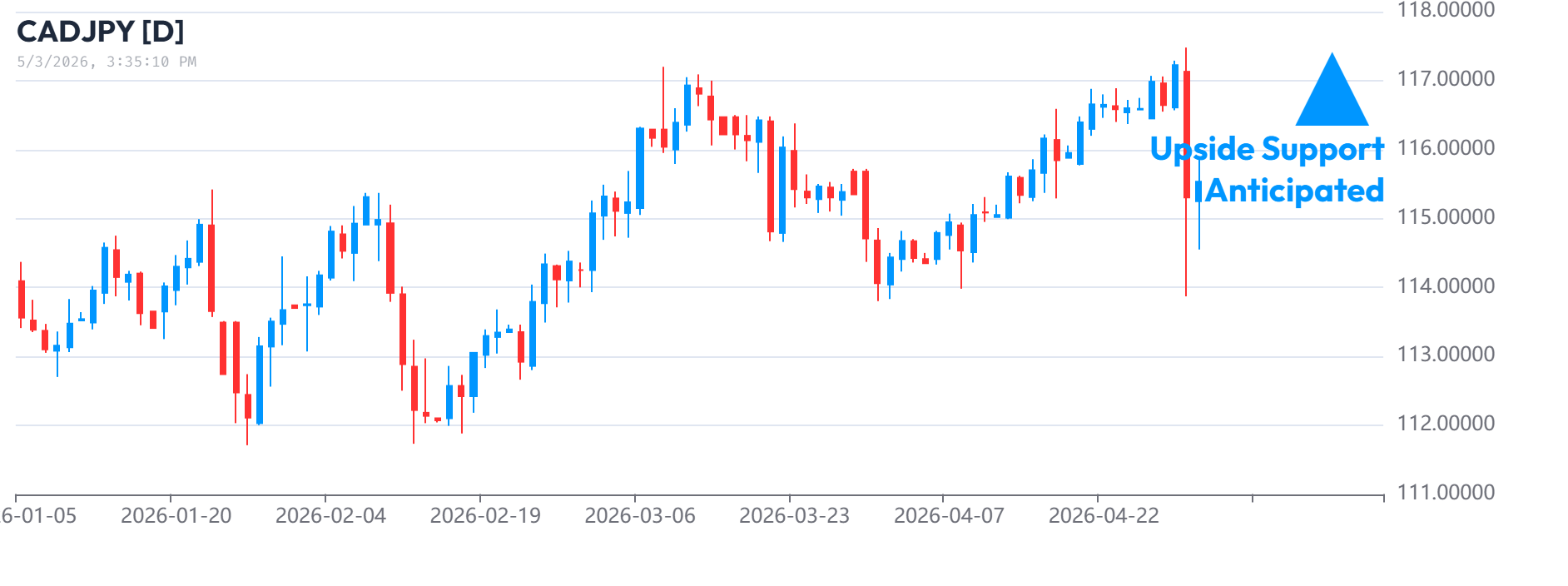
The fundamental outlook for CAD/JPY points to a highly confident upside trajectory. Over the past month, the Canadian Dollar has caught a tremendous tailwind from surging global oil prices. With Brent crude cresting above 118.40 USD per barrel in late April 2026 due to the ongoing Strait of Hormuz blockade, Canada’s status as a premier net energy exporter provides exceptional fundamental support. The Bank of Canada recently held rates steady at 2.25 percent with a hawkish tilt, acknowledging the sticky inflationary pressures stemming from crude oil. Commercial and institutional positioning remains net long, confirming that smart money expects the CAD to stay buoyant in these conditions.
Conversely, the Japanese Yen is sailing directly into gale-force headwinds. As a major energy importer, Japan suffers severe trade balance degradation from sustained high oil prices. The Bank of Japan held its policy rate steady at 0.75 percent in late April 2026, highlighting a structural yield disadvantage that continues to punish the Yen. Furthermore, speculative Commitment of Traders data shows leveraged funds remaining heavily net short on the JPY at 39 percent, underscoring a broad bearish consensus against the currency.
Looking at the upcoming days, we anticipate choppy waters. The Japanese Ministry of Finance has issued severe intervention warnings with USD/JPY hovering around the 155 to 160 mark. Any official market intervention to prop up the Yen would cause a sudden, sharp drop in CAD/JPY. Professional operators should view this risk not as a deterrent, but as a strategic advantage. A sudden intervention squall will likely wash out weak retail longs, providing a heavily discounted, high-probability entry point to buy CAD/JPY before the overarching macroeconomic currents resume pushing the pair higher. The primary risk to this thesis is an unexpected, immediate ceasefire in the Middle East, which would rapidly drain the oil premium.
POTENTIAL SELL EUR/CHF
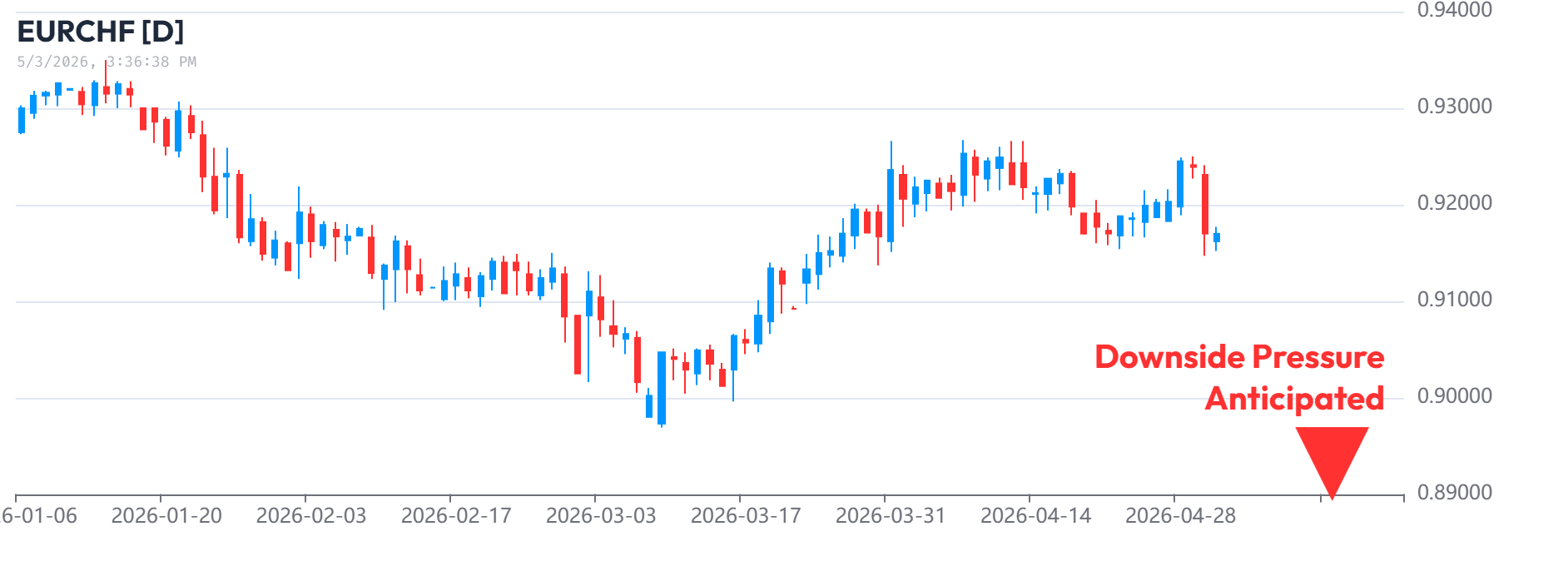
A highly confident downside conviction for EUR/CHF is likely over the upcoming weeks. The Euro is currently taking on heavy water, severely exposed to the Middle East energy shock. Late April 2026 data revealed Euro Area economic sentiment dropping sharply to 93.0, alongside surging consumer inflation expectations which hit 4.0. The European Central Bank faces a nightmare stagflation scenario, holding main refinancing rates steady at 2.15 percent but dealing with trimmed growth forecasts for 2026. CFTC reports reflect this grim reality, showing commercial dealers overwhelmingly short on Euro futures at 42 percent as they hedge against prolonged industrial weakness.
In stark contrast, the Swiss Franc is enjoying incredibly robust following seas. Positioned historically and structurally as Europe’s premier safe haven, commercial intermediaries currently hold a commanding 57 percent long position in CHF futures. Switzerland’s domestic inflation remains subdued compared to its neighbors, and the Swiss National Bank’s vigilant stance provides a stable anchor for capital preservation. The deep structural divergence between a struggling, energy-starved Eurozone and a heavily capitalized, safe-haven Switzerland strongly favours sustained downside for this currency pair.
In the short-term, pervasive risk-off sentiment tied to the geopolitical landscape will likely maintain a heavy downward pressure on EUR/CHF. However, any fleeting moments of risk-on sentiment, perhaps driven by passing rumours of diplomatic talks or a temporary plateau in oil prices, could cause the Euro to briefly float higher. We will view these minor counter-trend rallies as ideal premium entry points to execute short positions. The fundamental anchor for this trade is rock solid, but traders must diligently monitor the geopolitical radar. A sudden, verifiable de-escalation in the Middle East conflict would rapidly drain the safe-haven premium out of the CHF and offer the Euro a much-needed lifeline, invalidating the immediate bearish thesis.