
JAPAN, AND JPY
Monday, 09 February 2026 The immediate future for the JPY hinges on two things: proving the “virtuous cycle” is real and seeing how the market digests the government’s massive spending plans. Watch f

Monday, 09 February 2026
The immediate future for the JPY hinges on two things: proving the “virtuous cycle” is real and seeing how the market digests the government’s massive spending plans. Watch for confirmation that the economy grew in Q4 and whether the central bank has the nerve to hike rates again while bond yields are spiking.
Feb 15 Q4 2025 GDP Prel: Need to see a print above 1.6 percent annualised to confirm the economy has shaken off the Q3 slump.
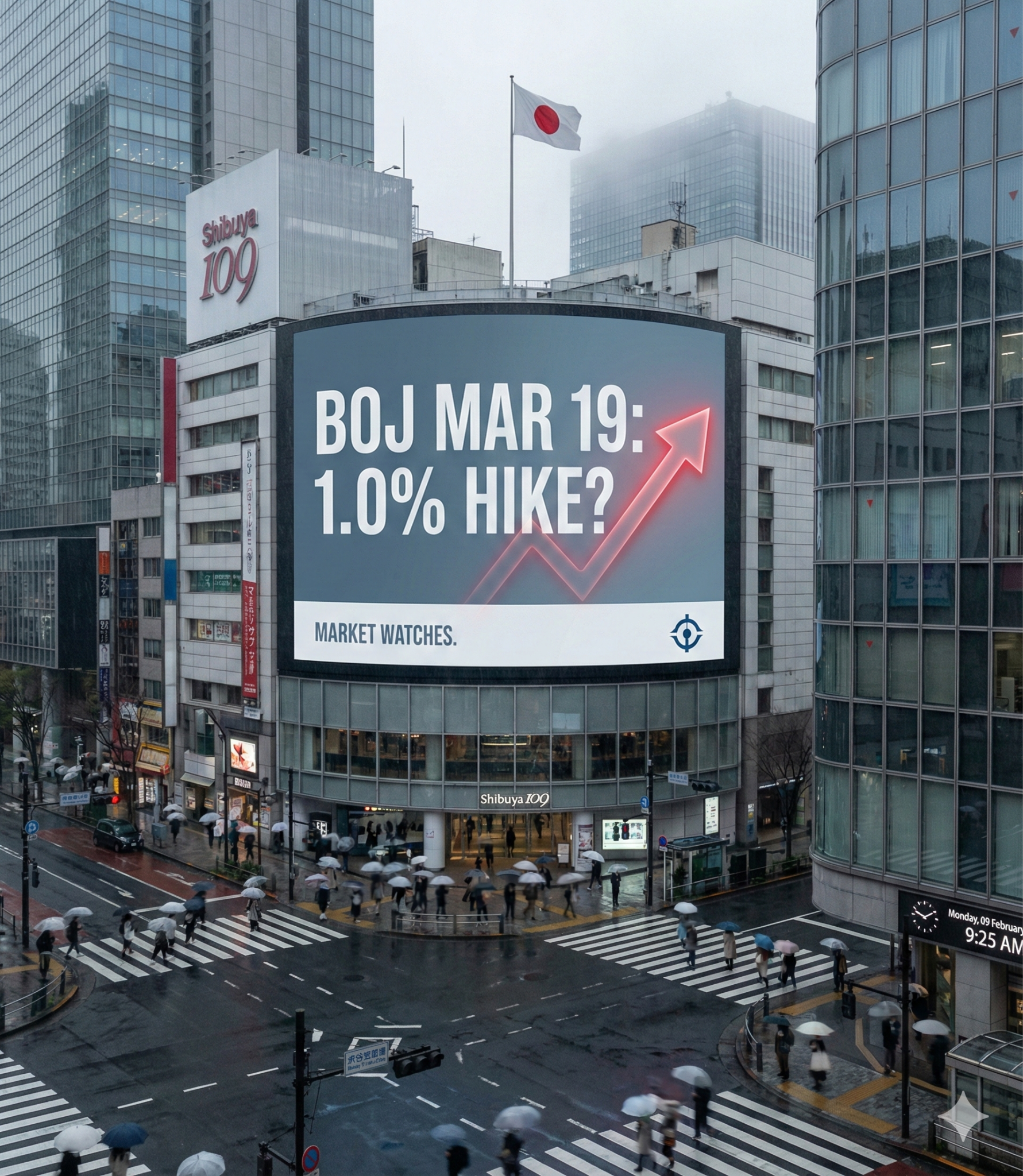
Mar 18-19 Bank of Japan Policy Meeting: With Takata already voting for a hike and inflation forecasts moving up, a move to 1.0 percent is possible.

POLITICAL HEGEMONY AND THE RETURN OF AGGRESSIVE FISCAL EXPANSION
Japan is currently defined by a massive clash in policy: the Takaichi administration is pushing the pedal to the metal on fiscal spending, while the Bank of Japan is slamming on the brakes with rate hikes. This creates a volatile mix where equities are rallying on stimulus hopes, but the bond market is crashing under the weight of new debt. For the Yen, it is a tug-of-war between domestic tightening support and the fear of fiscal irresponsibility.
The Consolidation Of Power Under Sanaenomics
If you have been tracking the political landscape in Japan, you know we have just witnessed a massive shift that will define the trading environment for months to come. Following the snap General Election held yesterday, Sunday, February 08, 2026, Prime Minister Sanae Takaichi has solidified an absolute hold on power. Her Liberal Democratic Party, along with its coalition partner the Japan Innovation Party, now controls a staggering 352 seats in the Lower House. For you as a trader, this supermajority is the single most important political variable right now because it grants the administration the constitutional power to override the Upper House. This effectively removes any legislative gridlock, clearing the runway for “Sanaenomics”—a bold mix of aggressive fiscal spending, national security investments, and strategic industrial subsidies. The opposition has essentially collapsed, with the Centrist Reform Alliance shrinking to just 49 seats, meaning there is virtually no political friction left to slow down this expansionary agenda.
Looking back at the previous seven months, you can see how fiscal policy has radically departed from the old austerity playbook. In November 2025, the Cabinet approved a massive 21.3 trillion JPY stimulus package, with 17.7 trillion JPY coming directly from the General Account. This wasn’t just vague promises; it included 11.7 trillion JPY specifically for price relief measures like electricity and gas subsidies, alongside cash handouts for families. As we look ahead to the upcoming seven weeks, your focus needs to be on the expedited passage of the FY2026 budget. This record-breaking budget totals 122.3 trillion JPY. While the Prime Minister is selling a story of fiscal health, independent analysts are flagging a likely structural deficit of around 7 trillion JPY. This reliance on 29.6 trillion JPY in new bond issuance is a huge supply shock waiting to hit the market. You need to watch this closely, because this level of unchecked spending introduces a real fiscal risk premium into Japanese assets, which could weigh heavily on the Yen if global investors lose faith in Japan’s fiscal discipline.
The Ueda Pivot And The Search For Neutrality
When we look at the Bank of Japan, we are seeing a historic transformation under Governor Kazuo Ueda. The central bank has essentially ripped up the old playbook of ultra-loose policy and is now aggressively hunting for a “neutral” interest rate. This isn’t the passive Bank of Japan of the last decade; the mandate has shifted from fighting deflation to managing a “virtuous cycle” where wages and prices rise together. Over the past seven months, they have backed this up with action. After holding steady through mid-2025, the Policy Board shocked the doves in December 2025 by hiking the uncollateralized overnight call rate to 0.75 percent—the highest level since 1995. They didn’t stop there; they also rolled out a formal plan to slash purchases of Japanese Government Bonds and ETFs, effectively killing off Yield Curve Control and letting market forces finally drive yields higher.
Right now, the monetary policy stance is defined by a clear “tightening bias,” and the internal drama is worth your attention. At the January 2026 meeting, the Board voted 8-1 to hold rates at 0.75 percent, but Board Member Takata dissented, pushing for an immediate hike to 1.0 percent. This dissent is a powerful signal for us. As we move into the upcoming seven weeks, all eyes will be on the March 18-19 Policy Meeting. With the central bank upgrading its inflation forecast to 1.9 percent for FY2026 and projecting GDP growth of 1.0 percent, the odds of a hike to 1.0 percent in March are very high. Remember, the Bank of Japan is currently the only major central bank in a tightening cycle. This divergence creates a structural floor for the Yen against the USD and EUR, assuming US yields don’t run away. You also need to keep a close watch on the bond buying operations; as they phase these out, we are seeing an aggressive steepening of the yield curve that changes the game for long-term positioning.
Structural Transformation Amidst A Soft Patch
The Japanese economy is currently navigating a tricky transition, moving from a volatile export-led model to a recovery driven more by domestic demand. If you look at the key industries, it is a tale of two sectors: semiconductors and defense are booming thanks to heavy government subsidies, while the traditional automotive giants are fighting headwinds from global trade fragmentation. Over the previous seven months, the economic data has been a bit of a rollercoaster. We saw the economy contract at an annualized rate of 2.3 percent in the third quarter of 2025, hammered by a widening trade deficit and companies drawing down inventories. But don’t let that backward-looking data fool you; the signals from late 2025 suggest a rebound is underway. The Leading Economic Index hit a 17-month high of 110.2 in December, which is a strong hint that the “soft patch” is officially over.
Inflation is shifting from being driven by import costs to being driven by demand, which is exactly what the Bank of Japan wants to see. While headline inflation slowed to 2.1 percent in December, that was largely due to energy subsidies masking the real heat. Core CPI is still sticky at 2.4 percent, and services inflation is climbing, proving that higher wages are being passed on to consumers. The labor market is incredibly tight, with unemployment at just 2.6 percent and 119 jobs for every 100 applicants. For the upcoming seven weeks, the biggest catalyst will be the spring wage negotiations, or “Shunto,” and the preliminary Q4 GDP release. A strong GDP print would basically confirm the Bank of Japan’s normalization path. Also, keep an eye on trade; Japan returned to a surplus of 105.7 billion JPY in December, driven by tech exports to the US and Taiwan. This is a crucial support pillar, but Japan’s reliance on external demand remains a vulnerability you can’t ignore given the shifting trade policies in the US.
MARKET DYNAMICS AND THE YIELD CURVE SHOCK

We are seeing a historic divergence in Japanese markets: stocks are skyrocketing on stimulus bets, but the bond market is selling off aggressively due to fears of fiscal oversupply. The JPY is stuck in the middle, pinned down by high US yields despite the Bank of Japan’s rate hikes. This is a high-risk environment where a sudden unwind of the carry trade could trigger massive volatility.
The Takaichi Trade And The Death Of The Widow Maker
If you are trading Japanese markets right now, you are witnessing a regime change that happens once in a generation. The financial markets associated with Japan are experiencing a simultaneous breakout in equities and a breakdown in bonds. Let’s talk about the bond market first, because the moves there are historic. Over the previous seven months, we have seen the definitive end of the “Bernanke put.” The 10-year Japanese Government Bond yield has ripped higher to 2.28 percent as of February 9, 2026. This isn’t just a small adjustment; it is a full-blown bear market in bonds. The drivers are clear: the Bank of Japan is stepping away from the market just as the government plans to flood it with 29.6 trillion JPY in new issuance for FY2026. We even saw the 40-year JGB yield surge above 4 percent in November, a level that was unthinkable just a year ago. The curve is steepening aggressively, meaning investors are demanding a much higher premium to hold long-term Japanese debt. For the upcoming seven weeks, expect this volatility to continue. If the FY2026 budget passes without any cuts to spending, yields could easily push higher.
On the equity side, the “Takaichi Trade” is in full swing. The Nikkei 225 has completely decoupled from the bond market distress, smashing through the 56,000 level. Investors are betting big that the combination of massive fiscal stimulus, corporate governance reforms, and a relatively weak yen will supercharge earnings. It is not an even rally, though. You are seeing a clear split: semiconductor stocks like Tokyo Electron are flying high on government subsidies, while banks like Mitsubishi UFJ are rallying because higher interest rates boost their lending margins. Conversely, the currency market is where the real conflict lies. The JPY is struggling to capitalize on the hawkish Bank of Japan, trading near 156.68 against the USD. The problem is the “carry trade.” Even with Japanese rates rising, US yields are still much higher, making it profitable to sell Yen and buy Dollars. However, this is a dangerous trade right now. As Japanese yields rise, the incentive for domestic investors to bring their money home increases. In commodities, Japan’s structural reliance on energy imports continues to weigh on the trade balance, and we have seen a surge in domestic rice prices that is keeping inflation expectations high and pressuring consumer sentiment.

ECONOMIC INDICATORS AND FORECASTS
With inflation stuck above 2 percent, unemployment at rock bottom, and GDP poised to bounce back in Q4, the fundamental case for the Bank of Japan to hike rates to 1.0 percent in March is gaining, assuming external demand doesn’t collapse.
Interest Rate
The Bank of Japan has decisively shifted from zero rates to a tightening cycle over the last seven months.
Next Release & Period: March 18-19, 2026.
Consensus: Markets are beginning to price in a high probability of a hike to 1.0 percent in March, driven by dissenting votes and upgraded inflation outlooks.
Economic Growth Rate (Annualized)
Growth has been volatile, with a sharp contraction in Q3 followed by recovery signs.
Next Release & Period: Q4 2025 GDP (Preliminary) is due on February 15, 2026.
Trading Economics Forecast: Expansion.
Consensus: Expectation is for a rebound to positive 1.6 percent to 2.0 percent annualized, confirming the exit from the Q3 soft patch.
Inflation Rate (YoY)
Headline inflation has moderated due to subsidies, but underlying pressure remains above target.
Next Release & Period: January 2026 National CPI is due on February 19, 2026.
Trading Economics Forecast: Near 2.0 percent.
Consensus: Core inflation is expected to remain sticky above 2.0 percent, justifying further rate hikes.
Unemployment Rate
The labor market remains at full employment levels.
Next Release & Period: January 2026 Unemployment Rate is due in late February.
Trading Economics Forecast: 2.5 percent to 2.6 percent.
Consensus: The tight labor market is expected to persist, supporting wage demands.
Employment Change / Labor Data
Data reflects the Jobs-to-Applicants ratio, a key metric for labor tightness in Japan.
Next Release & Period: January 2026 data due late February.
Trading Economics Forecast: Elevated ratios.
Consensus: Structural labor shortages will continue to drive wage competition.