UNITED STATES, AND USD
The United States economy is executing a “high-wire act” between massive fiscal expansion (OBBBA) and a Federal Reserve that has slammed the brakes on rate cuts. The pivotal market driver is the nomin
UNITED STATES, AND USD
Saturday, 14 February 2026
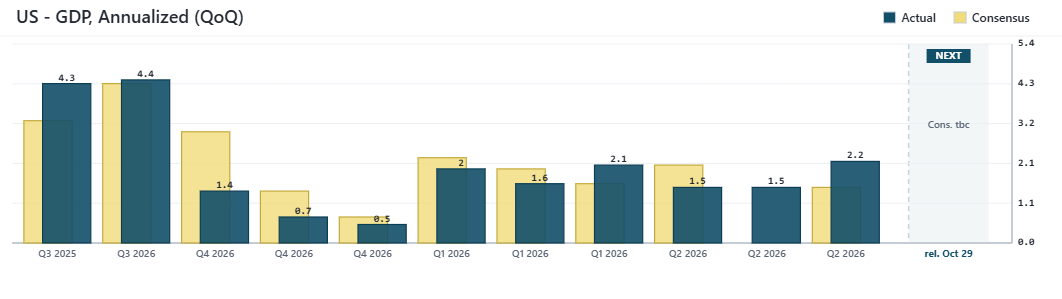
The United States economy is executing a “high-wire act” between massive fiscal expansion (OBBBA) and a Federal Reserve that has slammed the brakes on rate cuts. The pivotal market driver is the nomination of Kevin Warsh, which signals a regime shift toward “hard money” and deregulation, effectively putting a floor under the USD. While growth is robust (4.4% GDP in Q3), the cooling but still above-target inflation profile and massive debt issuance ($1.9T deficit) ensure that volatility will remain elevated. The USD remains a high-yield fortress, but it faces immediate tests from critical data releases that could either confirm the “no landing” thesis or reignite recession fears.
Feb 20 Release of Q4 2025 GDP Advance Estimate (Forecast: 3.5 percent). A beat here confirms US exceptionalism and rallies the USD.
Mar 17-18 FOMC The first meeting with new economic projections will reveal if the Fed officially pivots to a “hold” for the entirety of 2026.
FISCAL EXPANSION AND MONETARY HAWKISHNESS: A STRUCTURAL CLASH
The United States is locked in a high-stakes conflict between expansive fiscal policy—driven by 1.9 trillion USD deficits and tariffs—and a Federal Reserve that has halted rate cuts due to above-target inflation. The nomination of hawk Kevin Warsh to replace Powell signals a potential regime shift toward “hard money,” supporting the USD despite fiscal risks. Sentiment is cautious; robust growth data masks underlying labor volatility, making the currency highly sensitive to the upcoming March FOMC projections.
A Regime of Aggressive Protectionism and Deficit Spending
The federal government of the United States is currently operating under the second term of President Donald Trump, characterized by a radical restructuring of fiscal and trade paradigms. The administration has successfully implemented the “One Big Beautiful Bill Act” (OBBBA), signed into law on July 4, 2025, which permanently extended many of the 2017 tax cuts and raised the statutory debt ceiling by 5 trillion USD to a total of 41.1 trillion USD.
This legislative victory was steered by a cabinet focused on industrial deregulation and trade protectionism, led by Treasury Secretary Scott Bessent and Commerce Secretary Howard Lutnick. The administration’s mandate prioritizes “America First” economics, utilizing aggressive tariffs to incentivize domestic manufacturing while tolerating significant fiscal expansion.
Fiscal policy over the previous seven months has been defined by the immediate implementation of the OBBBA, which the Congressional Budget Office projects will add 4.7 trillion USD to deficits through 2035. The budget deficit for fiscal year 2026 is projected to hit 1.9 trillion USD, or 5.8 percent of Gross Domestic Product, driven heavily by debt servicing costs that are set to surpass 1 trillion USD annually. Looking ahead to the upcoming seven weeks, the focus will shift to the delivery of the State of the Union address and the submission of the fiscal year 2027 budget proposal. Traders must also navigate potential fiscal cliff brinkmanship related to appropriations deadlines, which introduces the risk of partial government shutdowns.
The Federal Reserve at a Hawk-Dove Crossroads
The Federal Reserve System is navigating a period of profound transition and internal division regarding the trajectory of monetary policy. Currently chaired by Jerome H. Powell, whose leadership is under intense scrutiny, the central bank faces a monumental shift with the nomination of Kevin Warsh as the next Chairman, announced on January 30, 2026. The Federal Open Market Committee (FOMC) has spent the last seven months attempting to calibrate policy against a “soft landing” narrative. After executing three rate cuts from September to December 2025 that brought the federal funds rate down to a range of 3.50 to 3.75 percent, the committee paused this easing cycle in January 2026.
In a 10-2 vote on January 28, 2026, the FOMC held rates steady, citing above-target inflation and a stabilizing labor market. This decision saw Governors Stephen I. Miran and Christopher J. Waller dissenting in favor of a 25 basis point cut — Miran arguing that monetary policy was tighter than necessary, and Waller focused on supporting the labor market. Over the next seven weeks, market attention will be fixated on the March 17-18 FOMC meeting, where the updated “dot plot” will reveal whether the central bank intends to hold rates higher for longer to combat tariff-induced inflation or cut rates to aid consumers. The looming Senate confirmation hearings for Kevin Warsh will further dictate market sentiment, as traders assess his willingness to balance the administration’s pro-growth fiscal agenda with the Fed’s price stability mandate.
A K-Shaped Economy Defined by Trade Realignment
The economy of the United States remains the global hegemon, yet it is undergoing a volatile structural transformation driven by supply chain decoupling and sectoral divergence. The economy has exhibited robust headline growth, with Q3 2025 GDP expanding at an annualized 4.4 percent, fueled by consumer spending and front-loaded exports. However, trade dynamics have shifted drastically; Mexico and Canada have cemented themselves as the top trading partners, while China’s share of US imports has plummeted to below 10 percent due to punitive tariffs.
Domestically, the economy displays a “K-shaped” recovery. While the healthcare and social assistance sectors are booming—driving significant job gains in January 2026—other sectors are struggling under the weight of high interest rates. The labor market has been erratic; following severe downward revisions for 2025 and a contraction in October linked to a government shutdown, Non-Farm Payrolls rebounded significantly in January 2026 with 130,000 new jobs. Looking forward, the next seven weeks will be critical in determining if this labor market resurgence is sustainable. Traders will be watching the February employment data and Q4 GDP revisions closely to see if the “no landing” economic scenario can withstand the headwinds of 1.9 trillion USD annual deficits and renewed inflationary pressures from tariffs.
ASSET CLASS VOLATILITY AND THE SAFE-HAVEN PARADOX
Financial markets are pricing in a dangerous divergence: equities are betting on a “Goldilocks” soft landing driven by AI, while gold and bonds are hedging against a sovereign debt crisis and persistent inflation. The bond market is the “truth-teller” here; rising term premiums suggest the Fed will be forced to keep rates higher for longer. This environment favors the USD as a high-yielding fortress currency, particularly if the “Warsh Fed” pivots to a harder inflation-fighting stance in March.
Divergent Markets: The Warsh Effect and Debt Anxiety
The financial markets associated with the United States are currently defined by extreme polarization, driven by the friction between the administration’s fiscal expansion and the Federal Reserve’s reluctance to ease monetary conditions further. In the bond market, this tension has manifested as volatility at the long end. Over the previous seven months, the 10-year Treasury yield has been highly volatile, peaking above 4.31 percent before settling near 4.05 percent in mid-February 2026. Investors are demanding higher term premiums to hold long-dated US debt, fearing that the 1.9 trillion USD annual deficit and the “One Big Beautiful Bill Act” will entrench inflation above target. Looking ahead, bond markets face significant risks over the next seven weeks from Treasury auctions and the March FOMC meeting; any signal that the “Warsh Fed” will prioritize inflation over growth could send yields spiking back toward cycle highs.
The stock market has largely ignored fiscal warnings, riding a wave of artificial intelligence enthusiasm to record highs. The S&P 500 briefly breached the historic 7,000 level on January 28, 2026, driven by mega-cap tech stocks like Nvidia and Alphabet. However, cracks are forming. Recent weeks have seen a rotation away from tech as investors question the ROI of massive AI capital expenditures, shifting funds toward industrials and financials that benefit from the administration’s deregulation agenda. In the commodities sector, Gold has surged near 5,044 USD per ounce in mid-February — though its all-time high of approximately 5,608 USD was reached in January 2026 — acting as a hedge against US sovereign debt debasement and geopolitical risk. Oil prices remain around 63 USD per barrel due to the “energy dominance” policy of maximizing domestic output.
The currency market has seen the USD behave as a high-yield safe haven. The US Dollar Index (DXY) sits near 96.915, having softened due to the second-half-of-2025 rate cuts but finding renewed support from the Fed’s January pause. The “Warsh Effect”—the anticipation of a more hawkish Fed Chair—combined with the protectionist trade stance, is creating a floor for the Greenback. Over the next seven weeks, the USD is poised for volatility; if inflation data re-accelerates, forcing the Fed to price out 2026 cuts entirely, the USD could execute a violent short-squeeze against the Euro and Yen.
INDICATORS
The quantitative data reveals a highly volatile economic engine that is re-accelerating after a stumble in early 2025. January’s strong NFP (130K) and drop in Unemployment (4.3 percent) contradict the recessionary signals from late 2025, suggesting resilience. However, the persistence of above-target core inflation (2.5 percent) and Interest Rates (3.75 percent) confirms that the Fed cannot ease further without risking price stability. Meanwhile, headline inflation eased to 2.4% in January, offering some respite. The data supports a “higher for longer” USD thesis.